
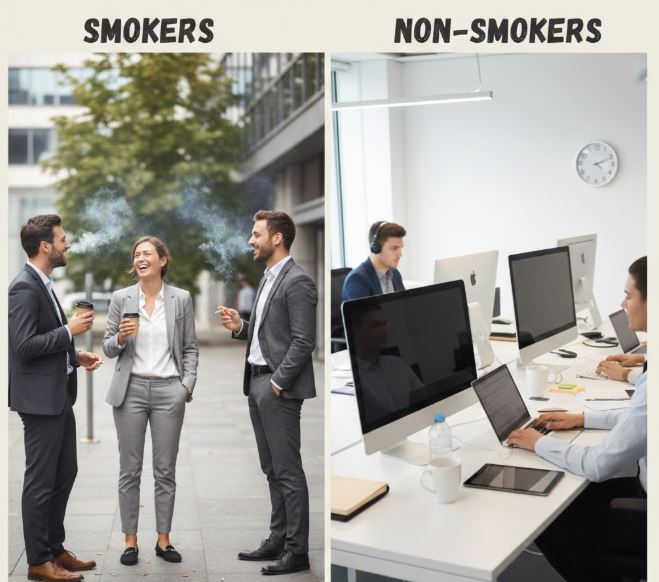
Comparing the productivity of smokers and non-smokers at work is an oversimplified view of a much more complex work dynamic. This blog challenges the very formulation of “ who is more productive” because it ignores the context: working conditions, stress, cultural norms, and personal regulation strategies.
We examine why a smoker may use a break not as a “distraction” but as a recovery mechanism, while a non-smoker may be susceptible to burnout by not allowing themselves to stop. Moreover, a focus on productivity reduces an employee’s value to the volume of tasks completed, ignoring the quality of attention, emotional investment, and the specifics of teamwork.
This blog does not offer blame, but calls for a shift in the conversation from labels to processes: how we work, what drains us, and where we find resources. Productivity is not a function of the presence of a habit, but a reflection of the environment in which a person operates.
Smoking break or loss of time: what the statistics say
The link “smoke breaks are a waste of time” sounds convincing, but it often hides simplifications and social stereotypes. This blog suggests looking at smoking breaks not as an exclusively harmful practice, but as an indicator of deep processes in the work culture.
We analyze how statistics can be used — and distorted — to confirm a predetermined idea: a smoker is supposedly less productive. However, the numbers do not take into account the nuances: the density of work, the effect of a short break on attention, and the level of stress. We also consider how smoke breaks themselves reproduce microsocial structures: discussions, connections, and informal exchange of information.
This text does not justify addiction, but questions unambiguous conclusions. Maybe the issue is not about smoke breaks, but about how work is organized? And perhaps the problem is not about smoking, but about the fact that resting at work is permissible only with a cigarette in hand.
Smoking at work: a break for rest or a decrease in productivity?
The idea of smoking as a break is a convenient myth that often hides real losses: time, concentration, and health. This blog challenges the established justification for a “smoke break” as a form of relaxation.
We examine what happens to attention, work rhythm, and teamwork when smoking becomes a regular part of the workday. Can these breaks be equated with full recovery, or are they just a substitute for another, more effective kind of pause? In addition, we consider the social imbalances: non-smoking employees are more likely to go without such “breaks”, which creates invisible tension and a sense of injustice.
Statistics speak not only about minutes “stolen” from work, but also about the overall dynamics of engagement. This blog is not an accusation, but an invitation to reconsider: what does break at work mean and how to make them truly restorative, for everyone, not just those with a cigarette in hand.
Non-smokers Win? The Impact of Habits on Work Performance
The wording “win” simplifies a complex picture: not smoking in itself does not make a person more productive, but the habits that accompany it can.
This blog challenges the binary opposition of smoking and non-smoking employees. We analyze which factors affect productivity: the ability to self-regulate, the ability to structure rest, and emotional stability. Non-smokers often create useful micro-breaks, while smoking breaks become the only way to “reboot”. But this is not universal. Some smokers use breaks consciously, while non-smokers can “burn” without stopping.
We consider how corporate culture amplifies or neutralizes differences in habits and why productivity is not a question of tobacco, but a question of environment and flexibility. This blog does not sum up, but expands the scope of the conversation: from the battle of habits to an understanding of how conditions are created in which a person works best.
Five Minutes of Smoke, an Hour of Loss: Smoking and Productivity
Linking a five-minute smoke break to an hour of lost time is a convenient, but not always accurate, formula. This blog explores why the conversation about the productivity of employees who smoke is often simplified to the arithmetic of lost time.
We ask: does smoking reduce your contribution to work, or are we ignoring other factors – overload, lack of proper breaks, emotional exhaustion? For many smokers, a cigarette break is the only way to “officially” rest, recharge their attention, and reduce anxiety.
But is this an excuse for addiction? We consider what alternatives might be more constructive for all employees, regardless of habits. This blog is not about blaming or justifying, but about reframing the very idea of productivity: not as a non-stop flow of tasks, but as a balance of work and recovery, where a break is not a loss, but a resource.
A smoker in the office: an expensive pleasure for the company?
Smoking in the office is not only a personal matter for the employee, but also a corporate factor with a complex price. This blog explores the hidden and obvious costs that a smoker can bring to a business: from lost working time for regular smoke breaks to tension within the team, where some “can quit” while others continue to work.
We analyze how the risk of illness increases and, as a result, the level of hospital and insurance costs. In addition, the issue of fairness is raised: non-smoking employees often redistribute the workload, compensating for colleagues ’ “breaks”. It also considers what the company can do: bans, encouragement of healthy practices, and support for smoking cessation.
This blog is not about stigma, but about awareness: how smoking affects not only the health of an individual, but also productivity, microclimate and even the reputation of the company because the office is not a personal space, but a living system, where every habit has consequences.
Tobacco -Free Productivity: Should Smoking Be Banned at Work?
Banning smoking at work seems like a logical step towards productivity – but the question requires more than a simple “ for” or “against”. This blog explores how smoking affects work processes, from lost time and decreased concentration to the informal connections that arise in smoking rooms. We examine how an attempt to limit tobacco can improve the overall atmosphere and reduce burnout among non-smokers. Still, it will also affect the psychological state of employees who smoke, especially if quitting is used as the only mechanism for relieving stress.
We also look at examples of companies: where the ban actually improved efficiency, and where it created unspoken discontent. This blog does not give a universal answer. Still, it suggests looking at the ban as part of a wider system of care for health, balance and equal conditions for all employees because productivity is not only the result, but also the environment in which it is achieved.
Work Time in Smoke: How Smoking Affects Corporate Performance
Smoking in the office is not only a personal behavior but also a factor affecting the productivity of the entire team. This blog questions the tacit acceptance of smoking breaks as a “natural” part of the workday. We analyze how much time is actually lost, how it affects the team’s rhythm, engagement, and workload uniformity. In addition, we discuss how smoking breaks can be an indicator of other problems: lack of structured breaks, high stress, and ineffective management.
The issue of fairness is also raised: non-smoking employees are more likely to continue working during others’ “ breaks”, which creates hidden tension. This blog does not blame, but asks important questions: how does corporate culture normalize or ignore smoking, and what can be a fair and productive approach? After all, efficiency is not only about KPIs and reports, but also about the microclimate, attention and respect for the resources of all employees.
Smoking and KPI: Is there a connection between bad habits and success?
The idea that smoking affects KPIs sounds great, but it hides an oversimplification of the complex reality of work. This blog invites you to take a critical look at the attempt to link a personal habit with professional performance. We analyze why such a connection can be false: a smoking employee is not necessarily less effective, and a non-smoker is more successful. The focus is on the factors that affect KPIs: energy management, concentration, and the ability to cope with stress.
Sometimes a cigarette is a signal of problems in the organization of work, a lack of recovery breaks, or a high level of anxiety. We also explore how corporate culture affects which habits are given space and which are not. This blog is not about justifying smoking, but about not replacing real analytics with convenient accusations. Because there are many variables between a cigarette and a KPI — and the most important of them is called “person”.
Smoking and non-smoking employees: who works more efficiently and why
Trying to compare the efficiency of smokers and non-smokers, we risk turning the complex working reality into a duel of stereotypes. This blog suggests abandoning the black-and-white view of “effective – ineffective” and looking deeper into the context, behavior, and work environment. We explore how productivity is affected not by the fact of smoking itself, but by a person’s ability to manage stress, build a daily rhythm, and regulate attention.
Why do some smokers lose focus, while others use a smoke break as a mini-meditation? Why can non-smokers be productive, but are prone to burnout due to the lack of breaks? The focus is not on the habit, but on its functionality in the system: does it help or hinder? This blog does not give simple answers, but asks the right questions. Because efficiency is not a status, but a dynamic in which it is not the smoke that is important, but the conscious choice of how to fill the working time.
Invisible Losses: How Smoking Affects Business from the Inside
Smoking in the workplace is not just a personal habit, but part of the corporate economy, the consequences of which often remain behind the scenes.
This blog shows how the “invisible costs” are expressed not only in lost minutes or overtime of colleagues, but also in the emotional climate, decreased trust and unequal distribution of resources. We analyze how the culture of smoking breaks can increase social barriers, reduce engagement and even affect career trajectories: smokers and non-smokers are often perceived differently by management and the team.
We also examine the hidden costs: from an increased risk of burnout to unfair productivity reviews. This blog is an invitation to look at smoking not as a medical or behavioral problem, but as a factor embedded in the corporate fabric. Because businesses not only lose time, they lose equality, attention, and the potential of the people they employ.
Conclusion
Productivity is not determined by the presence or absence of a bad habit – it is formed by the system in which this habit exists. This blog has shown that the opposition between smokers and non-smokers reveals not so much the difference in results, but in working conditions, ways of resting, and corporate culture.
It is not a cigarette that interferes with work, but the lack of the right to a break without excuses. And it is not quitting smoking that makes a person productive, but the ability to recover. Therefore, instead of dividing employees by habits, it is important to build an environment in which efficiency is supported by attention, and not by labels.