
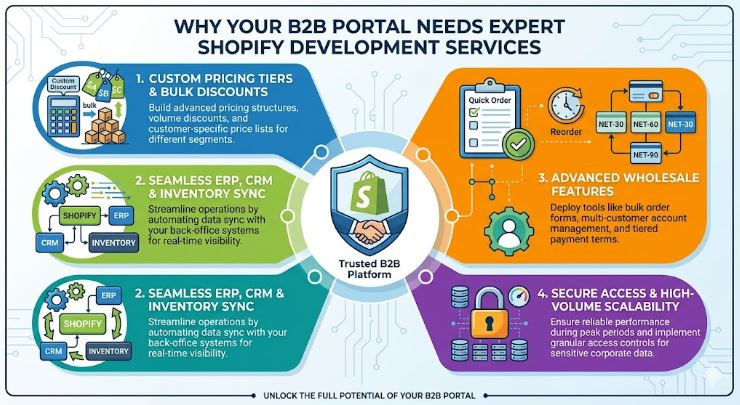
If you’re a distributor with a B2B ecommerce website, it’s not just an add-on. Your website is now your main channel where modern buyers place orders.
Outdated portals and phone calls can’t keep up with buyers who want consumer-grade clarity and speed. Distributors upgrading their B2B ecommerce experience grab more accounts. Meanwhile, those stuck in the old ways lose out to competitors offering seamless, self-serve options.
Every decision matters when building your perfect B2B ecommerce website. Here’s how Shopify website development services in Kolkata help you navigate the technological shifts and buyer expectations.
What the Modern B2B Buyer Wants
Buyers today are setting new standards for B2B ecommerce. If you want to make the best choice for your website, you need to understand how B2B buyers shop.
The Generational Shift
Digital-native, younger decision-makers dominate the B2B buying groups today. They are mostly Gen Z or millennial buyers whose expectations have been shaped by the ease of consumer purchases.
They compare options and expect immediate search results and correct inventory. They will abandon sites that have slow UX, user friction, or unclear pricing. Thus, here are a few website must-haves for distributors:
– Complete product data and neat categorisation.
– Real-time or almost-real-time availability via ERP platform integration.
– Intent-first experience.
– Seamless reorder experiences.
The gap between what most distributor portals offer and what buyers need is where revenue is lost. To close that gap, you need a Shopify development company in India, like Digital Concepts, who are well-versed with its B2B platform.
Guide to Technical Implementation
Architecture Choices
Your architecture choice impacts the website development workflow, customization limits, maintenance, and total cost of ownership. Distributors typically pick between theme-based or headless commerce via APIs.
Theme-Based Architecture
A theme-based build leverages the platform’s native storefront framework. Shopify development services will go for Online Store 2.0 and Liquid-based themes. These themes integrate seamlessly with core B2B website features, making it a straightforward setup.
With storefront and B2B logic in one environment, development and testing become seamless. This suits distributors with standard B2B ecommerce requirements like a quick setup and easy maintenance.
Headless Architecture
If you opt for headless, you split the front and back ends. Shopify holds B2B logic, products, orders, and customer data. Meanwhile, the front end is built with Next.js, Remix, or another JS framework via Storefront API and Hydrogen.
Headless architecture is suitable if:
– You need extremely customised B2B user interfaces that do more than what’s allowed by themes.
– You manage several storefront experiences or brands from a single back end.
– You require a special application layer that blends ecommerce with functional workflows.
– You have Shopify website design services ready to maintain the extra complication of autonomous frontend infrastructure.
Primary APIs and Integration Points
Integrations are the most challenging part of B2B ecommerce development. If data flow for pricing, inventory, orders, and buyer permissions isn’t spot on, customers won’t trust your site.
ERP Integration
Many distributor workflows rely on an ERP as the record system for:
– Multilocation inventory
– Account-level pricing and terms
– Order management and fulfillment
– Purchase order processing
For Shopify, the best website developers in India use Admin API and webhooks to sync data between systems, cutting out manual entry. This keeps buyers in the loop with real-time availability and contract pricing.
CRM Integration
CRM platforms hold all the details on customer accounts—contacts, communication history, sales notes, lifecycle data, etc. Linking Shopify B2B with your CRM syncs buyer roles, permissions, company notes, and order history across teams.
General integration should be able to:
– Sync company records when accounts change.
– Push orders to CRM for pipeline visibility.
– Update contacts and roles so sales teams are in the loop on buying authority.
SSO and Authentication
Big buyers often want SSO login via their own identity provider, ditching separate credentials. Shopify Plus supports this via OAuth or SAML/OIDC integrations—usually through apps or custom middleware.
Before diving into SSO, check if buyers actually need it. Many distributors assume it’s a must-have, but it adds complexity that smaller customers might not need.
Now’s the time to launch a B2B ecommerce site. Buyer preferences are shifting, and the technology is advancing every day. Upgrade the buying experience, and you’ll grab new customers and tap into growth markets in no time!
FAQs
- Should B2B distributors choose headless Shopify architecture or theme‑based builds?
Headless Shopify architecture is ideal for B2B distributors who want super-custom B2B interfaces that themes can’t deliver. It’s ideal if they are managing multiple brands from one backend or need to blend ecommerce with their workflows.
- What risks do distributors face with an old ecommerce platform?
B2B distributors with an outdated portal are encouraged to seek out Shopify website development services that are well-versed in tech advances. Otherwise, your old ecommerce platform can cause loss of revenue due to poor UX. Additionally, it can also –
– Create manual operational bottlenecks
– Show inaccurate pricing or inventory
– Reduce competitiveness in digital-first markets
- What makes Shopify the best platform for B2B ecommerce?
Shopify is best for B2B ecommerce development because it offers robust B2B features, including:
– The right architecture
– ERP and CRM systems
– Optimization for B2B buyers
– Secure authentication- Scalable performance overall


