Technology is really important for businesses that want to grow especially, in the USA. It helps them make money and do their daily work better. Technology also helps small businesses connect with their customers and compete with companies. If you have a delivery company, a software company or a company that offers services the technology you pick will affect how big your business can get. Technology plays a role in helping small businesses like yours grow and become successful.
Many small businesses face a common challenge. Some invest in too many tools that they do not really need. Others avoid investing in systems that could actually help them grow. The key is not to buy more software. The ultimate goal is to choose the right and relevant technology that dedicatedly supports all your business needs completely.
The framework that we are providing below will help you make smarter technology decisions and build a stack that truly supports your growth.
1. Start with Business Objectives and Not Tools
The technology you choose should directly support your defined business outcomes. Before contacting vendors or searching for platforms, conduct an internal strategy assessment. Also, predefine the following:
- Annual revenue targets
- Customer acquisition cost (CAC) benchmarks
- Lifetime value (LTV) goals
- Operational inefficiencies
- Compliance requirements
- Expansion roadmap
For example a retail startup in New York City needs a mobile commerce platform that has loyalty programs built in. This is because they have to compete with a lot of companies, in the city. On the other hand a company that sells to other businesses might care more about making their customer relationship management system work automatically and making their workflow better.
It is an idea to make a list of what technology you need before you start. This list should show how your business goals match up with what your organization needs. This way you can make sure you are spending money on things that will really help your business rather than just following the latest trend.
Best Practice: Quantify expected returns, for example, “reduce manual processing time by 40%” or “increase online conversion rate by 15%.”
2. Choose Between Custom and Ready Made Software Solutions
It is the time for determining the right type of software solution as per the business needs. Small businesses must make a right choice between the ready made and custom software solution. They need to consider whether ready-made software is sufficient or if custom development offers them strategic advantages.
Ready Made SaaS Software Solutions
- Rapid deployment
- Predictable subscription pricing
- Limited flexibility
- Vendor-controlled updates
These are ideal for non-differentiating functions such as payroll, accounting, email marketing, or HR management.
Custom Software or Mobile Applications
- Fully aligned with unique workflows
- Scalable architecture
- Competitive differentiation
- Ownership of property
If the thing that makes your business better than others is how users feel when they use your product or if you use automation or if you have special features that nobody else has, then working with a company that makes mobile apps in New York can be very helpful. They know a lot about what people in that area like and they know about the rules for keeping things safe and working well.
Working with app makers in Toronto is also an idea because they have very smart people who are good at engineering. They know a lot about artificial intelligence and software.
Strategic Insight: If the software you use is very important for making money then making your own custom software is often an idea, in the long run because it will save you more money.
3. Evaluate Scalability and Integration Capabilities
Your technology decisions should consider your 3 to 5-year growth plan. While assessing based on the following elements:
- API availability
- Third-party integration compatibility
- Cloud-native infrastructure
- Data synchronization capabilities
- System interoperability
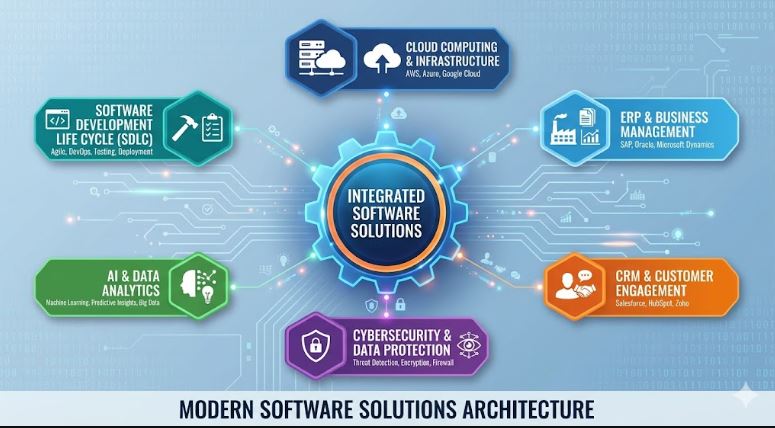
Cloud environments like Amazon Web Services and Microsoft Azure are really helpful. They let you scale up or down easily so your system is always available. Can recover from disasters. This is great for businesses because they can grow without having to spend a lot of money on new servers.
When all your systems do not work well together it can cause a lot of problems. You might have the data in many places, which is a waste of time.. When you try to make reports the numbers might not add up. So it is an idea to make sure that your Cloud environments and other tools like your customer relationship manager, accounting software, payment gateway, inventory system and mobile applications all work together smoothly.
4. Consider the Total Cost of Ownership
Many businesses do not realise the costs that can slow down their growth and cost them a lot of money.These extra and big costs can really harm a small business. Your financial evaluation of any technology should include:
- Initial development or licensing fees
- Cloud hosting costs
- Maintenance and updates
- Technical support contracts
- Integration expenses
- Employee training
- Downtime risk
A lower upfront SaaS fee may become expensive over five years due to scaling user licenses or add-on features. Conversely, custom solutions may require higher initial capital but offer predictable long-term cost control.
While engaging a strategic partner such as Impero IT Services can help conduct feasibility analysis and long-term cost modeling before implementation.
Financial Approach: Compare 3-year and 5-year TCO projections, as against year-one expenses.
5. Assess Vendor Expertise and Industry Experience
Selecting a technology provider is not a transactional one-time task but a long-term partnership decision. You should evaluate based on:
- Portfolio relevance
- Industry-specific experience
- Technology stack expertise
- Project management methodologies like Agile, Scrum, etc.
- Post-launch support capabilities
- Communication transparency
Here is an example for you to understand. A mobile app development company in New York that works with fintech knows how important it is to keep people’s information safe, make sure transactions go smoothly and follow the rules. Similarly, experienced mobile app developers in Toronto are also very good at what they do. They are really good at AI integration, SaaS scalability and cross-platform engineering.
Due Diligence Tip: Request reference calls with previous clients before finalizing contracts.
6. Shift Your Focus on User Experience and The Journey of Customer
Your selected technology’s success is determined by its adoption rates. It may be evaluated on the following factors:
- Intuitive interface design
- Accessibility compliance with ADA standards
- Performance optimization
- Cross-platform consistency
- Onboarding simplicity
The user-centric design increases retention and reduces support costs. Your applications should load quickly, minimize friction, and guide users toward desired actions. This necessitates conducting usability tests before full deployment is done. And even the small design improvements can significantly impact conversion metrics.
Metric to Monitor: Task completion rate and drop-off points in the customer journey.
7. Build for Data-Driven Decision Making
The technology selected by you for your small business should provide actionable intelligence and not just operational automation. This ensures your systems offer:
- Real-time analytics dashboards
- Predictive insights
- Automated reporting
- Customer segmentation tools
- Behavioral analytics
Using business intelligence tools helps the people in charge make decisions based on facts. When you can see what is going on with your business data you can make guesses about what will happen in the future. This also helps you plan your inventory, measuring the Return of Investment (ROI) of marketing and make your business run smoothly. Business intelligence tools are really useful for collecting business data thoroughly.
Advanced Consideration: Confirm database architecture supports future AI and machine learning integration.
8. Start Lean, Then Iterate
To make your small business achieve success in 2026, you need to avoid overbuilding during the initial phase and adopt a phased implementation model. For your reference, below is an implementation model:
- Clearly Define Your Minimum Viable Product (MVP)
- Launch with core features
- Collect customer feedback
- Analyze performance data
- Optimize and scale
This reduces financial exposure and accelerates time-to-market. It also allows real-world validation before allocating larger budgets.
Wrapping Up!
Choosing the right technology solutions for small businesses in the most developed countries like the USA requires a very careful evaluation and a planning that is very clear and dedicated towards the business needs. Business owners need to thoroughly consider their costs, review technical requirements, and think about long-term goals before making any kind of decision for your small business.
Your primary and ultimate goal should always be clear business value and for that whether you work with a top-tier mobile app development company in New York to achieve this through local innovations, or join forces with app developers in Toronto to gain broader expertise.
Today technology is more than something we use to get work done. The technology a company uses matters because it affects how the company operates, how the company grows and how the company competes over time. When companies make technology decisions that fit with what they want to achieve in the run they are making a solid plan for the future of the company. This way of doing things helps companies deal with changes and succeed in a world where technology is always changing fast.