
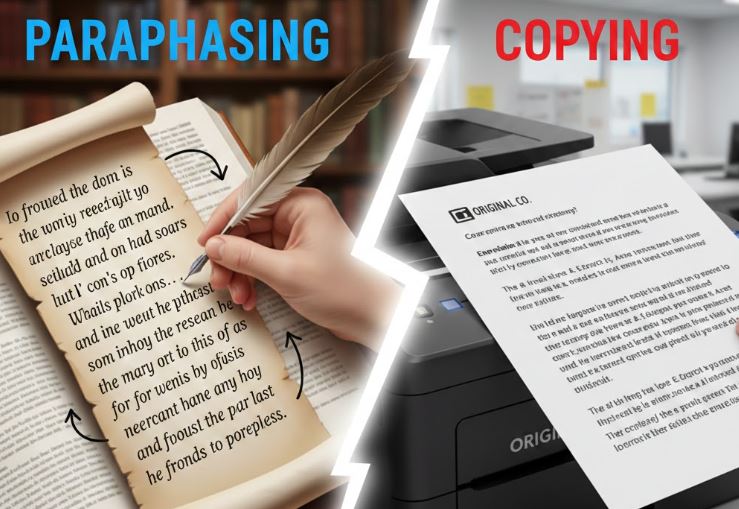
Let us accept that academic writing is tough, especially when we do not have enough time to write on our own. The pain of trying to convey complicated thoughts. even as you continuously question your syntax vocabulary, and tone, is probably familiar to everybody for whom English isn’t their first language. Students in this difficult situation go for copying the content or paraphrasing it. Paraphrasing is an essential skill in academic writing that allows students and researchers to present information in their own words while maintaining the original meaning. This can lead to failure, denial of assignments or maybe investigations as well. But in reality students often must strike a compromise between the two. Knowing each capability and when to apply it is a crucial skill that could improve your writing and make a whole lot of university life simpler, and seeking academic writing help can make this balance easier to achieve. They can seek help from our experts, ensuring submission on time with good-quality assignments. In this blog, we will discuss the difference between these two and their impact on students’ academic performance.
Paraphrasing VS copying
What is paraphrasing?
Paraphrasing refers to changing the whole paragraph into your own language. This is a process in which people restate or change the ideas of someone else in their own words. This is basically done by students in their assignments to complete them on time or because of a lack of knowledge. They do it by keeping the original meaning of the paragraph the same but by changing the vocabulary or the whole sentence in their own voice. Paraphrasing is also done to provide a clear and simple understanding of the concepts and to avoid plagiarism. This includes changing the structure of sentences, using synonyms, and changing the phrasing of phrases while maintaining the basic idea. This is a common way to incorporate research findings provide clarity for complex ideas and support an argument without actually quoting a source in academic writing. In paraphrasing people use different vocabulary as synonyms or phrase the sentence differently than the original work.
Paraphrasing also helps in avoiding plagiarism; without citing the references or rephrasing the paragraph, you might get caught for plagiarism in your assignments.
What is copying?
Copying is an act of creating a duplicate of someone else’s work and representing it in your own way. It can be information, an object, or someone’s behavior. In this, the students do not edit or rephrase the content or structure; they make similar work. It is a technique that is done to steal and present someone else’s work as your own without credit, and make any changes. Students having a hectic schedule or lacking knowledge often do this when writing assignments, any paper, or any other work to submit their work before the deadline. Understanding how authors write or express their ideas, and structure them clearly and logically, can also be a reason people copy to get that writing habit. Copying can be done intentionally. It avoids efforts by not citing any references, which leads to a plagiarism risk. It uses identical wording or synonyms to make it look like it is not copied, but it actually consisted of cheating. Faculty or professionals use AI tools as they know students who lack knowledge and are not able to meet deadlines will copy the work done by someone else to detect plagiarism.
| Difference | Paraphrasing | Copying |
|---|---|---|
| Define | This is a process of rewriting the content in your own language. | This is a process of reproducing the content or someone else’s idea. |
| Goal | The goal is to represent your own ideas and understanding. | The goal is to present someone else’s work as your own. |
| Process | Read, understand, and rephrase or change the structure, keeping the same meaning. | It avoids efforts. |
| Citation | Citation is required. | Citation is missing. |
| Wording | There is a complete change of vocabulary by changing or rephrasing the sentence. | Using identical wording, such as synonyms. |
| Length | Length is similar by focusing on the point, maintaining the same meaning. | Can be a single paragraph or the whole content to be the same. |
| Attribution | It credits the real source to avoid plagiarism. | Present the work as their own without acknowledging the source. |
| Effort | Understand the work and rewrite it in your own words. | Skips the process of understanding the work. |
| Risk | This is safe and has zero risk of plagiarism | Easily detect plagiarism with AI tools, and it is considered cheating |
To sum it up
In essence, paraphrasing is basically telling a story in your own language that you have heard from someone else, and copying is imitating or mocking someone else’s work, the same so that it resembles it. It restructures the sentence to maintain the original meaning. It requires significant structuring and changes of vocabulary, whereas copying fails to do this, which risks plagiarism. Students often do both paraphrasing and copying the content while writing their assignments. They are unaware of the consequences they can face for detecting plagiarism. Students can run to an academic expert for help to rephrase their content clearly and logically.